

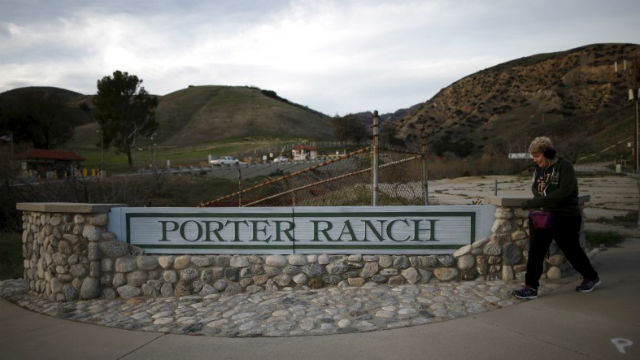
Attorneys for the state and SoCalGas have until 6 p.m. Saturday to respond to an appellate court ruling that blocked the reopening of the controversial Aliso Canyon gas storage facility that has been closed since a giant methane leak forced dozens of residents from their Porter Ranch homes.
The methane leak that reportedly sickened nearby residents was the largest such incident in U.S. history.
The order blocking the reopening was issued Friday by the 2nd District of Appeals following an emergency filing by attorneys for Los Angeles County.
Under the order, SoCalGas is “temporarily enjoined from injecting natural gas into the Aliso Canyon underground reservoir” pending further consideration of the issue.
The appellate ruling came just hours after a Superior Court judge declined to block the re-start of natural gas injections at the gas storage facility in Porter Ranch.
In that lower court ruling Friday afternoon, Los Angeles Superior Court Judge John Shepard Wiley Jr. rejected the county’s request for a temporary restraining order blocking the re-start of Aliso Canyon, saying he did not have the authority to “interfere” in the operation of a facility governed by the California Public Utilities Commission.
County attorneys quickly took the matter to the Court of Appeals, prompting the late-afternoon appellate order that reached a much different conclusion than Wiley’s decision.
SoCalGas has sought to restart operations at Aliso Canyon and last week state regulators announced gas injections could resume in a limited fashion, primarily to prevent electrical supply shortages in Southern California.
After the state and/or SoCalGas file responses, the appellate court “will issue a further order continuing or dissolving this temporary stay.”
Los Angeles County Supervisor Kathryn Barger called the appellate court ruling “a victory for the residents of Porter Ranch and the northwest San Fernando Valley.
This ruling recognizes that there are still significant issues that need to be considered by the court before re-injection is allowed at the Aliso Canyon facility, including an analysis for the root-cause of the massive 2015 blowout, seismic risk assessments, and a long-term energy reliability study,” Barger said.
“The county will continue to explore all available opportunities to determine what future actions can be taken to ensure the health and safety of the community.”
SoCalGas officials said the leak was discovered on Oct. 24, 2015 and continued spewing methane until it a Feb. 11, 2016 announcement that the leak was capped. At its peak, an estimated 15,000 Porter Ranch area residents were temporarily relocated.
A study by researchers at the U.C. campuses in Irvine and Davis determined the leak spewed enough methane into the air each day to “fill a balloon the size of the Rose Bowl” and confirmed it was the largest in the nation’s history.
But SoCalGas officials have said the facility is now ready to re-open and provide much-needed resources.
“The California Public Utilities Commission has said that`delaying the resumption of injections after (the state Division of Oil, Gas and Geothermal Resources) has completed its safety determination may itself pose a continued public safety and reliability risk to the Los Angeles Basin.’ We agree with their assessment,” Chris Gilbride, SoCalGas’ director of media relations and public information, told City News Service.
“Moreover, the CPUC has directed SoCalGas to maintain natural gas inventories at Aliso Canyon necessary to support the reliability of the region’s natural gas and electricity systems. Unnecessary delays will challenge our ability to meet that directive.
SoCalGas has met, and in many cases, exceeded the requirements of the State’s year and a half long review of safety at Aliso Canyon.
However, county officials objected, saying the facility should not reopen until a study is completed on the cause of the 2015-16 gas leak. They also argued that further study is needed on the possible damage a large earthquake could cause to the storage field.
According to the California Public Utilities Commission and the state Division of Oil, Gas and Geothermal Resources, the investigation into the cause of the leak is continuing, but the facility is safe to resume limited operations.
In order to protect public safety and the environment, this facility will be held to the most rigorous monitoring, inspection and safety requirements in the nation and will store only the minimum gas necessary to supply the Los Angeles area,” said Ken Harris, the division’s oil and gas supervisor. “The extensive testing, retrofits and new safety measures ensure the wells are in sound operating condition today.”
CPUC Executive Director Timothy Sullivan said the facility will be restricted to about 28 percent of its operating capacity, “just enough to avoid energy disruptions in the Los Angeles area.”
Concerns have been raised in the months since the leak about the possibility of electrical shortages due to the lack of natural gas from the Porter Ranch-area facility to operate power plants.
Critics have blasted such claims as scare tactics meant to pressure regulators into allowing Aliso Canyon to resume operating — an accusation SoCalGas executives vehemently deny.
“Aliso Canyon is an important part of Southern California’s energy system, supporting the reliability of natural gas and electricity services for millions of people,” according to the Gas Co.
If ultimately allowed, it was not clear when gas injections would resume at the facility. SoCalGas officials said they were more than halfway through the process of meeting requirements for re-starting injections.
The Aliso Canyon storage facility has been largely out of use since the nearly four-month leak spewed about 109,000 metric tons of methane into the air.
In court papers filed Monday, attorneys for the county argued that Aliso Canyon “cannot withstand” a major earthquake, and there is a 60 percent to 80 percent chance of such a temblor occurring in the Aliso Canyon area over the next 50 years.
SoCalGas officials said concerns about seismic safety were “carefully considered” by state regulators before they decided the facility is safe to resume limited operations.
Claims being made by attorneys for the county in hopes of preventing renewed operations at Aliso Canyon are “baseless and wrong,” according to SoCalGas.
“Aliso Canyon is safe to operate. This is not just our conclusion, but the conclusion of the only state regulators with lawful jurisdiction and expertise to oversee the safety of our operations.”
However, Barger said she will continue pushing to prevent the facility from re-starting.
“The county’s first priority is to protect the health and safety of the residents of Porter Ranch and the northwest San Fernando Valley,” Barger said.
“I believe that allowing Aliso Canyon to begin re-injecting puts the residents in a potentially unsafe environment.”
—City News Service